Asymptotic Analysis: Overview and Limitations
Asymptotic analysis attempts to compute the time period of any operation in mathematical units of computation.
It attempts to estimate the resource consumption of the operation. Typically, you will analyze the time required for an algorithm and the space required for data.
The commonly used asymptotic notations to calculate the running time complexity of an algorithm are:
- Big-Omega (Ω) — best case (minimum time required for program execution).
- Big-Theta (Θ) — average case (average time required for program execution).
- Big-O (O) — worst case (maximum time required for program execution).
How Do We Measure The Performance Value Of Algorithms?
Big O Notation is commonly used to know the maximum time required for program execution and it is basically only a mathematical analysis to provide a reference on the resources consumed by the algorithm.
• Big O describes how the time taken, or memory used, by a program scales with the amount of data it has to work on.
Complete algorithm analysis is impossible. In fact, it is not even possible to tell whether an algorithm will finish. Fortunately, most useful algorithms are subject to fairly straightforward asymptotic analysis.
In most general cases, algorithm analysis is important. Despite the importance of algorithm analysis, it has its limitations.
Algorithms with better complexity are often more complicated. This can increase coding time and the constants.
The majority of algorithmic tasks in practice do not deal with large data and in most cases a much simpler algorithm could be better even though it might not be relatively faster compared to the complex algorithm.
Asymptotic analysis does not consider small input cases as carefully as it considers other cases with higher input. Considering small input sizes, constant factors or low order terms could dominate running time, causing one algorithm to outperform another even if Big-O says they are the same.
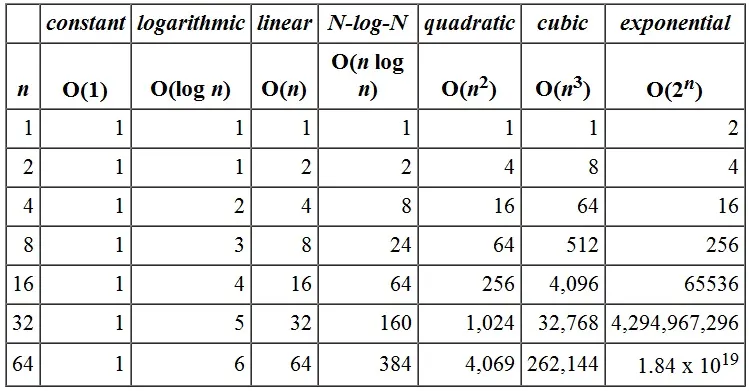
Illustrative runtimes showing O(n), O(n log n), O(n^2), and O(2^n). Image source: Cal Poly Pomona CS240 lectures — original image was unavailable, so an illustrative graphic is used.
For example, the running time of one operation may be computed as f(n²) and for another operation it may be computed as g(2^n). For small n the first operation may be acceptable while the second is impractical for larger n. In a similar manner, the running time of both operations will be nearly the same if n is significantly small.
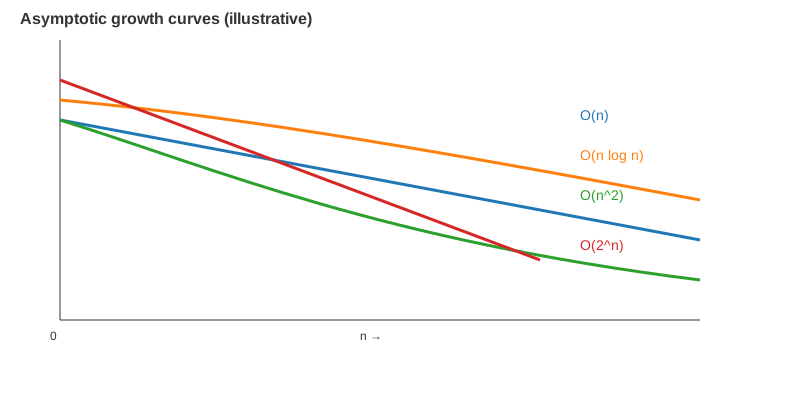
Illustrative growth curves showing O(n), O(n log n), O(n^2), and O(2^n). Image source: Cal Poly Pomona CS240 lectures — original image was unavailable, so an illustrative graphic is used.
Constant factors are always ignored in asymptotic analysis for most algorithm comparisons. In certain cases, when running an algorithm on smaller input, the constants can have a large effect when comparing algorithms. For instance, if the problem is to sort a collection of seven records, then an algorithm designed for sorting millions of records is probably not appropriate, even though it might have an asymptotic analysis that indicates good performance. If one algorithm takes O(n) time to execute and the other takes O(100000n) time to execute, then per Big O both algorithms have equal time complexity. In real-time application systems this may be a serious consideration — Big-O analysis often hides true costs of operations involved in the algorithm.
The running time of an algorithm depends on how long it takes a computer to run the lines of code of the algorithm and that depends on many other factors including the speed of the computer, the programming language, and the compiler that translates the program.
Asymptotic analysis might not be the ideal method for selecting an algorithm but it gives the programmer enough information. That said, asymptotic performance analysis can be quite helpful as the starting point for reasoning about the performance of algorithms and data structures; one must understand its limitations to be a competent and better programmer.
References
- Cal Poly Pomona — CS240: Algorithm Analysis (mentioned image source)
- Asymptotic analysis — Wikipedia
- Introduction to Algorithms (CLRS)
Originally published on Medium — Jul 17, 2021.